Compound-Curvature Panel Study
Building doubly-curved surfaces that stay smooth under a microscope.
- Year
- 2024
- Software
- SolidWorks
- Focus
- Surface Modeling · Curvature Continuity · Bodywork
Overview
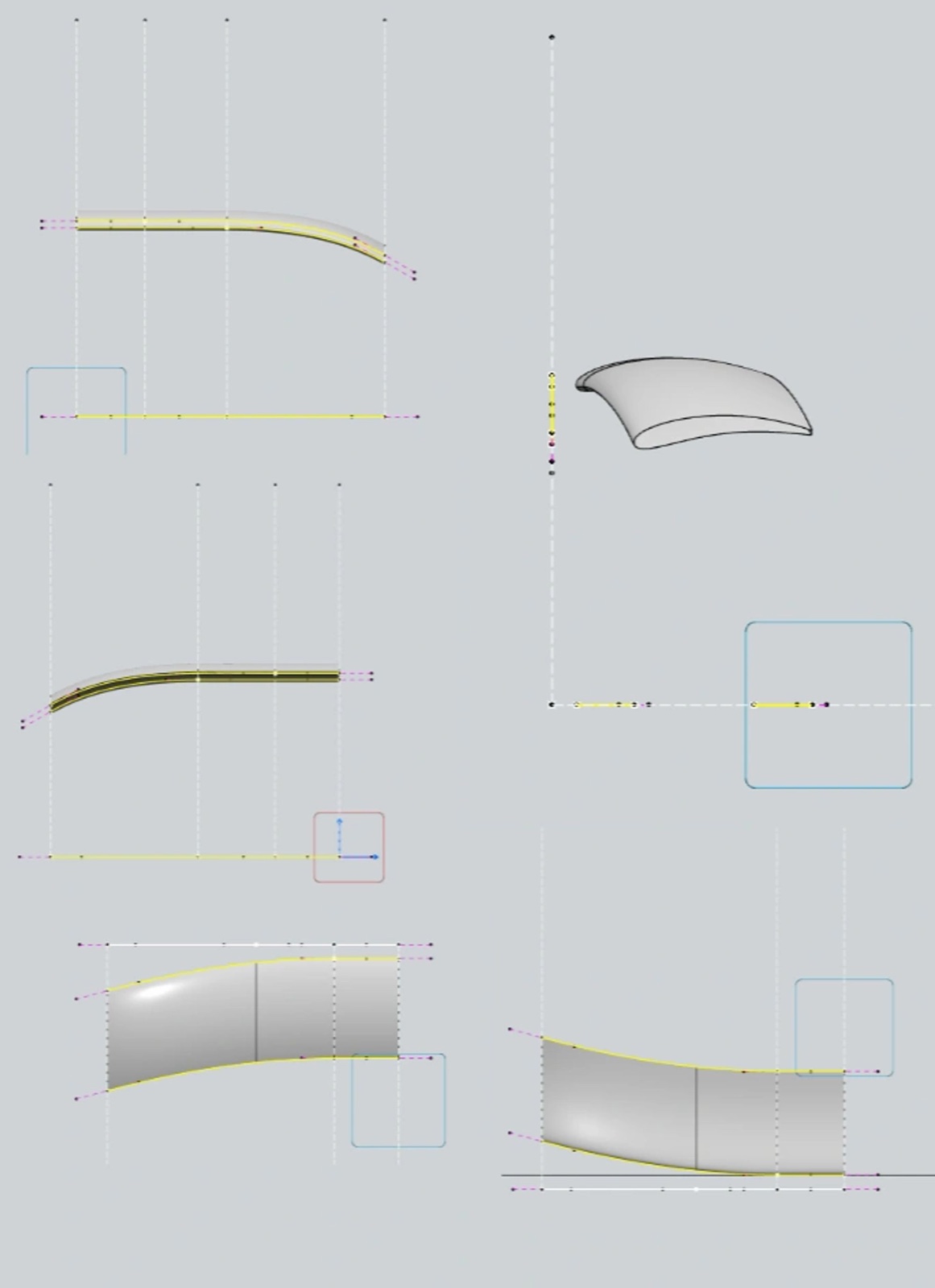
This study strips surfacing down to its hardest core: creating panels that curve in two directions at once and still meet neighbouring surfaces without a visible break.
I built the panels from a network of splines and boundary curves — the same approach used for automotive and aerospace bodywork — to understand how control-point placement drives surface quality.
The aim was not a finished object but a repeatable technique I could carry into any bodywork or aero project.
Engineering process
Decisions, iterations, and tradeoffs.
- 01
Spline networks
The surfaces are driven by intersecting splines whose control polygons I tuned by hand. Small moves in a control point ripple across the whole panel — learning to feel that relationship was the point of the exercise.
- 02
Continuity between panels
Adjacent panels are matched for curvature continuity, so reflections flow across the seam. This is the difference between surfaces that look premium and surfaces that look CAD-generated.
- 03
Evaluating relentlessly
I leaned on zebra and curvature analysis throughout, rebuilding sections that looked fine but evaluated poorly. The tools see what the eye forgives.
Gallery
CAD · Surfacing · Renders
What I learned
Surface quality is decided at the control points long before the surface exists.
Curvature-continuous seams are what separate designed surfaces from generated ones.
Reflection analysis is not optional on Class-A work — it is the actual spec.
Next project