Multi-Element Aero Surface
A motorsport-inspired study in high-curvature aerodynamic surfacing.
- Year
- 2024
- Software
- SolidWorks
- Focus
- Surface Modeling · Aerodynamics · Class-A Surfacing
Overview
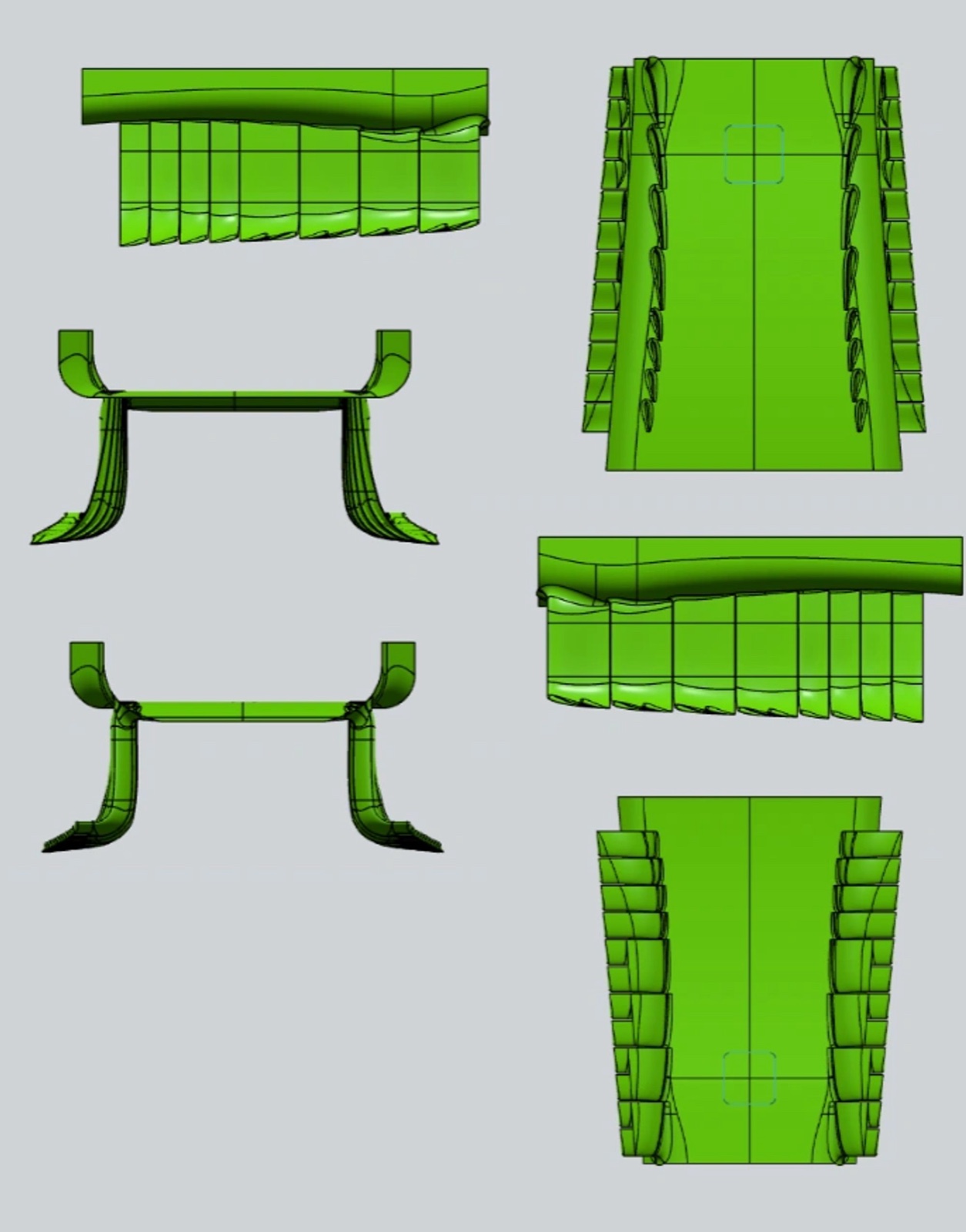
A personal CAD study inspired by the aerodynamic bodywork I saw discussed during my time around the Aston Martin Aramco F1 team. It is my own concept geometry, built to practice the surfacing techniques that motorsport aero relies on.
The piece explores a stacked, multi-element form: a primary surface feeding into a cascade of trailing flaps, each with its own twist and gurney-style trailing edge.
The challenge was maintaining smooth, aerodynamically plausible surfaces across many closely-spaced elements without the geometry collapsing or self-intersecting.
Engineering process
Decisions, iterations, and tradeoffs.
- 01
Element strategy
I modeled each flap as an independent lofted surface driven by shared boundary curves, so the spacing and twist of the cascade could be adjusted as a family rather than one rigid solid.
- 02
Managing high curvature
The tight radii where elements roll over their trailing edges were the failure point in early attempts. Rebuilding those regions with dedicated boundary surfaces kept the transitions continuous instead of faceted.
- 03
Reading the flow intent
Even as a static study, I shaped the channels between elements to suggest an intended flow path — a reminder that aero surfaces are the visible answer to an invisible problem.
Gallery
CAD · Surfacing · Renders
What I learned
Surfacing many adjacent elements is a bookkeeping problem as much as a geometry one — shared reference curves keep the family coherent.
High-curvature roll-overs are where surface quality lives or dies; they deserve dedicated geometry, not a global fillet.
With more time I would run the concept through basic flow visualization to test whether the shapes do what they imply.
Next project